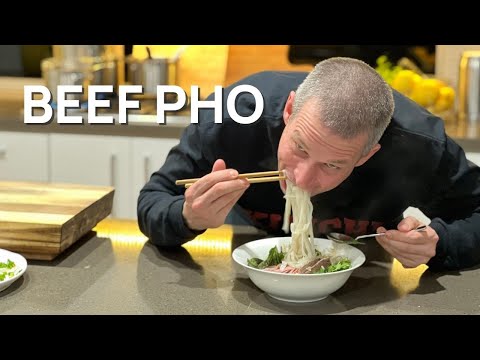
Source video by Andy Cooks on YouTube. This recipe was adapted with strict source-fidelity rules and is marked for human review.
Andy Cooks builds his pho the traditional way: roasted beef bones, onions and ginger charred over an open flame, and whole spices (coriander seed, black cardamom, cinnamon, clove, star anise) toasted before they go anywhere near the pot. The chuck sears off in a hot pan, then simmers in the broth for two hours before it's pulled out to slice. We've kept the char, toast and sear on the hob because a slow cooker can do none of them, then moved the long stock simmer into the pot. Serve over rice noodles with thinly sliced raw rib eye, bean sprouts, Thai basil, coriander, chilli and lime, and pour the hot broth over the top to cook the raw beef at the table.
Slow cooker notes: Source is a hob and oven recipe. The bone roast (200C oven, 35 to 40 minutes), the charring of onions and ginger over an open flame, the dry toasting of the whole spices and the caramelisation of the chuck all stay off the slow cooker because slow cookers steam rather than roast, char, toast or sear. The roasted bones, charred aromatics, toasted spices, seared chuck, fish sauce, rock sugar and 6 litres of water then go into the slow cooker for the long stock simmer in place of Andy's 4 hour hob simmer. The chuck is lifted out after roughly the first third of the cook (about 3 hours on Low or 2 hours on High) so it can cool and be sliced, then the bones keep cooking. Noodles, sliced raw rib eye, herbs, bean sprouts, sliced white onion, chilli and lime are all assembled outside the pot and finished by ladling the hot broth over at the table. Default servings set to 6 as the chef does not state a yield.
Ingredients
- 2.75 kgbeef bones, a mix of marrow bones (cut in half), knuckles and rib bones
- beef chuck, in one piece
- brown onions, root trimmed, halved, skin left on, charred until very dark
- fresh ginger, cut lengthways down the middle, charred until very dark
- coriander seeds, dry-toasted
- black cardamom pods, dry-toasted
- cinnamon stick, dry-toasted
- whole cloves, dry-toasted
- star anise, dry-toasted
- 35 grock sugar
- good-quality fish sauce
- 6 Lcold water
- salt
- black pepper
- rice noodles, soaked in cold water, then blanched in boiling water (add late)
- rib eye steak, par-frozen for about 30 minutes, then sliced as thin as possible (add late)
- bean sprouts (add late)
- white onion, finely sliced (add late)
- spring onions, sliced (add late)
- Thai basil, leaves picked (add late)
- fresh coriander, leaves picked (add late)
- bird's eye chillies, sliced (add late)
- lime, cut into wedges (add late)
- extra fish sauce (add late)
Method
Heat the oven to 200C. Spread the beef bones on a tray (no salt, no oil) and roast for 35 to 40 minutes, until nice and golden brown. Chef prefers roasting to the traditional boil-and-skim for a deeper beefy flavour.
~40 minWhile the bones roast, char the aromatics. Trim the root end off the onions, halve them and set them cut side down straight over an open gas flame on a trivet. Cook until very dark, then set aside. Do the same with the halved ginger.
~15 minDry-toast the coriander seeds, black cardamom, cinnamon, cloves and star anise in a hot pan until fragrant. Tip them out and reserve.
~3 minSeason the chuck all over with salt and pepper. In the same hot pan, sear it hard on every side until you have a proper caramelised crust. Take your time; the crust does a lot of the flavour work in the finished broth.
~10 minTip the roasted bones into the slow cooker and pour over the 6 litres of cold water. Leave to sit for 5 minutes, then skim off any foam or scum that rises. Add the charred onions, charred ginger, toasted whole spices, rock sugar and fish sauce.
~10 minNestle the seared chuck into the pot, cover and cook on Low. This replaces Andy's hob simmer.
~60 minAfter about 3 hours on Low (or roughly 2 hours on High), lift the chuck out, wrap it and let it cool. The bones and aromatics carry on cooking in the broth.
~5 minCover again and continue cooking the broth on Low for a further 5 to 7 hours (total time on Low 8 to 10 hours, or 5 to 6 hours on High), until it's deeply beefy and aromatic.
~420 minWhile the broth finishes, prep the garnishes: soak the rice noodles in cold water, cut lime wedges, finely slice the white onion and pick the Thai basil, coriander and spring onion. Slice the bird's eye chilli if using.
~10 minTake the par-frozen rib eye out of the freezer (about half an hour in the freezer is plenty) and slice it as thinly as you possibly can. It goes into the bowl raw and cooks in the hot broth.
~5 minSlice the rested chuck across the grain (halve it down the middle, then cut strips).
~3 minBring a pan of water to a rapid boil and blanch the drained noodles briefly, then divide them between warm bowls.
~3 minLayer the sliced raw rib eye, sliced cooked chuck, bean sprouts and white onion into each bowl over the noodles. Strain hot broth straight from the slow cooker over the top so the raw beef cooks in the heat.
~3 minFinish each bowl with spring onions, coriander, Thai basil, a few chilli slices if you like heat, a good squeeze of lime and an extra splash of fish sauce to taste.
~2 min